Office Clearance in Woolwich
Office clearance in Woolwich needs a practical approach that keeps business disruption low while moving furniture, paperwork, equipment and general contents through the site in an orderly way. We provide a service shaped around the type of office space involved, whether that means a small suite, a shared workspace, a larger commercial floor or a premises that needs to be emptied ahead of a handover. The aim is straightforward: remove what no longer needs to stay, separate what may be reused or recycled, and leave the cleared areas ready for what comes next.
Our office clearance work covers a broad range of items found in working environments, from desks, chairs and cabinets to archive boxes, shelving, reception furniture and redundant fixtures. We also handle mixed contents where there are different materials, varied access routes and items that need careful handling. Good clearance work depends on sorting as you go, because not every item belongs in the same stream and not every workplace can be cleared in a single sequence. That is why we plan around the layout and the contents, not around a one-size-fits-all method.
If you are preparing a clearance, the most useful first step is to think about what should be removed, what should stay and whether anything needs to be separated before work begins. A clear brief helps us organise labour and loading efficiently, and it also reduces the chance of confusion once the clearance starts. When there are cupboards, storage rooms or back-office areas involved, those details matter because they affect how the work is carried out and what can be moved safely.
Clearance for desks, storage and everyday office contents
Office spaces often contain a mixture of large and small items, and that mix changes the way a clearance has to be approached. Desks may need dismantling, lockable pedestals may need checking, and filing units can contain loose documents or hardware that should be dealt with separately. Chairs, visitor seating and meeting tables can often be moved as a group, but tighter areas may need a more measured sequence so that corridors, stairwells and lifts remain usable while the work is underway.
We also deal with the kinds of contents that tend to build up quietly in active workplaces: spare monitors, obsolete accessories, packaging, promotional stock, broken items and general surplus from reorganisations. Some clients want a full emptying of one room or floor; others only need selected items taken away so that a workspace can be reconfigured. Either way, the service is about removing the right materials in the right order, not simply taking everything at once.
For office clearance requests that involve mixed furniture and equipment, useful preparation usually comes down to three things:
- Identify what is to be removed and what is remaining in place.
- Set aside any documents, keys, devices or other items that need separate attention.
- Make sure access routes are as clear as possible for moving larger objects.
Equipment, storage and workspace items
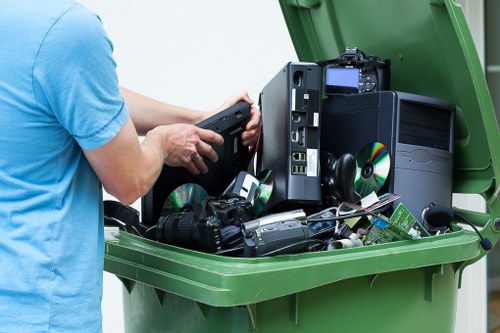
Modern offices rarely contain only furniture. They also accumulate screens, printers, small office machines, shelving components, files, lockers, decorative items and other operational contents that need to be handled with care. Where a clearance includes mixed office equipment, we work with the practical differences between materials and sizes so that items can be separated appropriately rather than bundled together without thought. That is especially relevant when contents include metals, plastics, timber and reusable fittings in one space.
Some clearances are tied to a reorganisation, a lease end or a relocation, while others follow a gradual reduction in floor space. In those situations, the order of removal can matter just as much as the volume being taken away. A room full of lightweight items may be easy to empty quickly, yet a few heavier pieces can affect the whole job if they are left until last. Careful planning helps ensure that awkward furniture, stacks of boxes and storage units are dealt with in a way that suits the building and the time available.
Where useful, we can work from item-by-item instructions or from a broader description of the area to be cleared. That flexibility is important in workplaces where different departments share the same premises, because one team may be finished with its furniture while another still needs access to cabinets or equipment. The more clearly those distinctions are set out, the easier it is to carry out a tidy and controlled office clearance.
Furniture disposal and reuse choices
Not every item removed from an office is automatically treated the same way. Some furniture may be suitable for reuse, some may be broken down for material recovery, and some may need to be taken away as general waste depending on its condition and construction. This distinction matters in office clearance because the contents of a workplace often include items that still have value in use, alongside pieces that are too worn or damaged to keep. The right approach is to assess the item, not to assume its route in advance.
Office chairs, desks, filing cupboards, meeting tables and reception furniture can each present different challenges. Flat-pack items may be straightforward to dismantle, while heavier wood-based furniture may take more time to move and sort. Soft seating and laminate units can also require separate handling depending on their materials. A thoughtful service therefore considers both the practical handling and the final destination of each piece, rather than treating office clearance as a single undifferentiated load.
We focus on sensible separation and removal, especially where clients want a tidy result without leaving behind mixed piles for later. If a workplace is being refitted, that can also mean coordinating around items that need to stay accessible until contractors or staff have finished with them. Tell us what is staying, what is going, and what needs careful handling. That makes the process more efficient from the start.
Documents, archives and back-office contents

Office clearance is not only about visible furniture. Many workplaces also contain storage rooms, archive areas and desk-side filing that may hold sensitive or long-retained records. Those contents need a careful approach because they are not just bulky items to be moved; they are information-bearing materials that should be separated, checked and handled according to the instructions given for the premises. A well-run clearance takes account of those distinctions before anything is removed from site.
Where archive boxes, filing cabinets or paper-heavy storage are present, we can work through the area in a structured way so that relevant items are not mixed into general contents by mistake. The same applies to drawers, cupboard shelves and old workstation storage that often contain a blend of stationery, manuals, hardware and papers. These mixed spaces benefit from a slow, deliberate sequence rather than a rushed approach, because the contents are often more varied than they first appear.
For offices with long-established storage, it is often useful to separate materials into groups before the main clearance starts. That may include files to remain, items to be shredded or retained elsewhere, and contents that can be removed as part of the emptying process. This kind of sorting does not need to be complicated, but it does need to be clear. Simple instructions save time later, especially where multiple rooms or departments are involved.
Working around access, buildings and occupied premises
Office clearance in Woolwich may involve premises that are still partly in use, and that makes access and timing an important part of the job. Lifts, staircases, corridors, reception points and loading areas all influence how furniture and contents are moved. Where spaces are shared or occupied, we aim to keep routes clear, avoid unnecessary disruption and work in a way that suits the building’s practical limits. The clearance method should fit the premises, not the other way around.
Some sites present narrow access, upper-floor rooms or awkward corners that need extra attention during removal. Others have open-plan layouts but large quantities of items that still need sorting by type or location. In either case, the process is easier when the team knows what is in each space before removal begins. That is why office clearance works best when room use, storage arrangement and any access restrictions are explained clearly at the outset.
If the site has items that need to be moved in stages, we can structure the work around those stages rather than forcing everything into one sweep. That is often helpful during refits, staged departures or end-of-tenancy handovers where some rooms are emptying before others. Pricing and quotes can then be discussed against the actual scope of the work, rather than against guesswork about the contents.
What affects the cost of an office clearance
Several practical factors can influence the scale of an office clearance. The volume of furniture and equipment is one consideration, but so are access arrangements, the number of rooms, the amount of sorting needed and the type of items being removed. A clearance that involves straightforward furnishings will usually differ from one that includes archives, dismantling, mixed materials or multiple floors. Clear information at the beginning helps shape a more accurate quotation.
It also helps to know whether the job is a full emptying or a partial clearance. Full office clearances tend to include more varied contents and may need a longer sequence of removal, while partial clearances often focus on a specific room, department or category of item. Either way, the objective is to match the work to the site conditions and the outcome you want. That is the most reliable way to produce a sensible plan for the job.
If you need a broader overview of what can be removed from a commercial site, our business waste removal page explains the wider service context. For offices specifically, however, the main issue is usually how to empty or reduce the space in a way that leaves it orderly. A brief, accurate description of the premises is usually enough to begin.
Office clearance for different kinds of premises
Not every workplace is arranged the same way, so the service has to remain adaptable. Small professional rooms, shared suites, administrative floors and mixed-use premises can each involve different contents and different movement routes. The same applies to offices with reception areas, staff kitchens, storage cupboards or meeting rooms. A practical office clearance takes those differences into account so that each section of the site is approached in a suitable order.
Some clients need a light clear-out before new furniture arrives, while others need a deeper emptying because the space is changing use or being handed back. In some cases, there are still everyday items in circulation, so the clearance has to work around operational necessities. In others, the site is already closed or nearly empty, and the task is more about finishing the final stages efficiently. Both situations benefit from clear instructions and a straightforward plan.
For wider property-related clean-outs, a home clearance can be useful to compare if you are dealing with mixed contents outside a work setting. But an office job has its own character: more desks, more storage units, more paperwork and more staged removal decisions. That is why the service is organised around workplace contents first, rather than treating every removal as identical.
Preparing for a smooth quotation and visit
When you ask for a quotation, the most helpful details are usually the rooms involved, the types of furniture or equipment present, and any access issues that could affect moving time. Photos can be useful if they show the main contents clearly, but they are not the only way to describe the work. A concise list of the key items, plus any instructions about what must stay behind, gives a solid starting point for assessing the job properly.
If there are records, computers, locks, keys or other items that need separate treatment, mention those at the same time rather than leaving them to be discovered on site. That does not mean writing a long inventory; it simply means highlighting anything that changes the handling of the clearance. This approach helps us shape a clear plan and avoids confusion on the day. It is also the best way to keep the process focused on the office contents that actually need moving.
If you are ready to compare options or move things forward, contact us with a short description of the office, the items involved and the area to be cleared. We can then discuss the practical scope and provide a quotation based on the information supplied. A well-prepared enquiry usually leads to a much clearer and more useful response.
About Woolwich
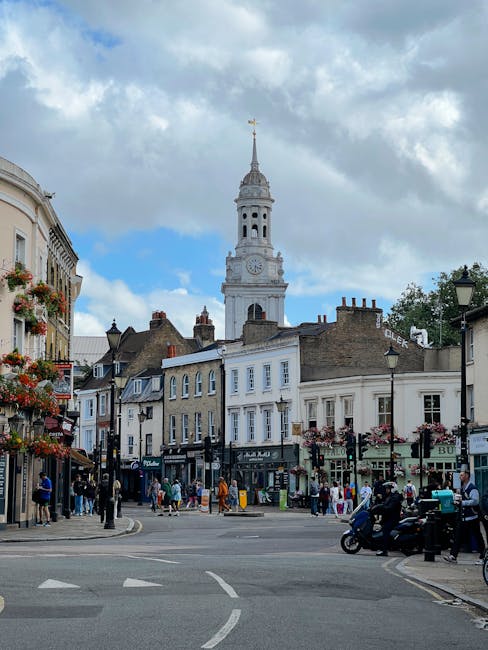
Woolwich is a historic district in south-east London, on the south bank of the River Thames within the Royal Borough of Greenwich. Its riverside position has shaped its identity for centuries, with the area developing around maritime and military activity and later evolving into a busy urban centre. The Royal Arsenal is one of its best-known historic sites; this large former military complex once played a major role in artillery production and storage, and parts of it have been redeveloped for housing, leisure and local amenities. Nearby, the Woolwich Ferry remains a notable Thames crossing, linking the district with North Woolwich on the opposite bank. Transport connections also include the Elizabeth line, with Woolwich station bringing the area into closer connection with central London and beyond. The district’s built environment is varied, with Georgian, Victorian and later architecture standing alongside newer developments. General Gordon Square and Beresford Square provide focal points in the town centre, while the landscaped open spaces at Woolwich Common add a green contrast to the denser streets around the centre. The Royal Borough’s civic presence is reflected in Woolwich Town Hall and the surrounding public buildings, and the area also has a long-standing market tradition that continues to contribute to local life. Woolwich’s riverside setting, transport links and layered history make it a place where old and new uses sit closely together, and that mix is visible in both the streetscape and the pattern of everyday activity.
Other clearances and related removals

Although office clearance is the main service here, some clients also need help with connected spaces such as storage rooms, staff areas, garages or lofts attached to mixed-use premises. In those cases, the clearance may involve items that sit outside the core office fit-out but still belong to the same building or tenancy. The work can be grouped where appropriate so that one removal plan deals with several linked areas rather than treating them as entirely separate jobs.
Related clearance tasks often include old furniture, stored packaging, redundant fixtures, broken fittings and other surplus contents that have accumulated over time. It is usually best to group items by location and by type before removal begins, because that keeps the work organised and makes it easier to check that nothing useful is taken by mistake. We can also discuss wider site clearance where a workplace has already been stripped back and only the remaining contents still need attention.
If you are comparing related services, our office clearance page is the best starting point for the core service, while furniture clearance may help where the job is mainly about furniture rather than broader workplace contents. When you are ready, request a quotation with the main rooms, item types and access details, and we can take it from there.